How Vehicle Dynamics Measurement Software Removes Approximation from Chassis Setup
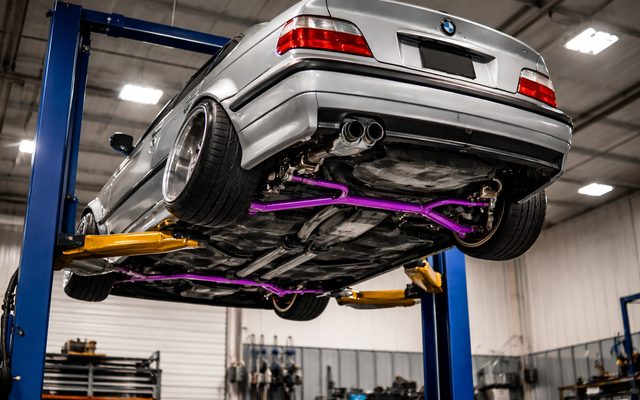
Within the intensely competitive arena of modern professional sliding, victory is not merely purely a result of sheer torque or pilot courage. Conversely, it has evolved into a complex engineering challenge which necessitates a painstaking blend of selecting a time-tested vehicle platform, equipping it with the most precise competition hardware, and, most critically, understanding its dynamic characteristics on the course through cutting-edge drift telemetry software. This exhaustive guide functions as your blueprint from the very first idea of a competition vehicle right through to the final telemetry-optimized adjustments that transform a strong vehicle into a predictable podium finisher. We will thoroughly explore the precise engineering of car suspension tuning, demonstrating how a advanced drift tuning app like precise measurement hardware removes assumptions and provides exceptional visibility into your car's actual performance.
The foundation of any great drift car is, without question, the chassis itself. Certain cars have attained renowned status within the international oversteer culture due to their built-in balance, durable design, and the vast availability of aftermarket support available. Choosing the correct car is the first and most important selection a driver will make. To illustrate, the BMW E36 is universally acknowledged as among the best all-around drift cars of history. Its almost ideal evenly distributed mass, alongside a driven rear axle layout and robust six-cylinder motors, forms a platform that is simultaneously forgiving for beginners and highly effective in the possession of a expert competitor. The successor of this lineage, the BMW E46, refines these attributes with a increasingly sophisticated structure, wider wheel track for improved confidence, and still a greater degree of steering angle as standard from the manufacturer. Another powerful platform in the pro circuit is the C6 generation Corvette.
This American track weapon brings a unique array of benefits to the drifting world, such as a lightweight aluminum frame, a transaxle-style drivetrain component that helps create an excellent balance, and the immense thrust of a large-displacement LS V8 motor. This combination renders it an utter monster on track, designed of entering and sustaining long angles with seemingly easy application of power. For drivers looking for remarkable value, the 350Z model Nissan stands out as a top-tier candidate. It arrives from the factory with a robust chassis, a effective original limited-slip differential, and the free-revving V6 motor that delivers sufficient power and torque for practicing and progressing in the discipline. Its newer version, the Nissan 370Z, presents further advancements in structural rigidity, steering geometry, and overall engine power, cementing its position as a favorite selection among serious drivers. Further iconic vehicles that deserve attention include the lightweight rotary-powered Mazda FC RX-7, the most popular S13 Silvia/240SX, the torque-rich Ford Mustang SN95, the electronic-equipped E90 3 Series, and the small yet unbelievably engaging and teachable Mazda MX-5. Every single one of these platforms gives a distinct set of attributes, difficulties, and potentials, but they all possess the core ingredients required to become a capable drift machine.
However, choosing the correct car is only the first step. To unlock the true performance of every of these cars, substantial modifications to the steering and suspension systems are utterly mandatory. This is where the realm of precision aftermarket hardware enters critical focus. The most most game-changing modification for a dedicated drift car is the fitting of a drift-spec angle modification kit. These engineered assemblies, for example those developed by industry leaders like SLR, are designed to radically increase the chassis's possible lock-to-lock rotation. A OEM road car is highly constrained in how far its steering tires can rotate, a engineering trade-off for on-road use. In drifting, but, aggressive steering input is constantly necessary to manage and maintain a slide. An steering kit exchanges the stock steering knuckles, tie rods, and often suspension arms with pieces that permit the steered wheels to achieve angles in excess of 70 or even 80 degs, as opposed to a normal OEM angle of around 40 to 50 °.
This vastly greater steering angle gives the driver with significantly more command during a angle, allowing it to be considerably easier to start a oversteer moment, sustain it through a extended bend, and transition seamlessly from one side to another. The contrast in handling is nothing short of transformative. Combined with a properly chosen steering kit is the every bit as vital modification to the car's suspension. Generic or even expensive road coilovers are just not designed for the particular and brutal needs of sliding. A drift-spec pair of coilovers is crucial. These specialized dampers have specific piston tuning and spring stiffness that are designed for the extreme mass transition that is inherent of aggressive driving. When a pilot starts a drift, the chassis's inertia is transferred forcefully to the outside of the bend. Correct competition coilovers handle this movement in a consistent manner, permitting the car to settle promptly and providing the driver accurate feel through the controls and driver's seat. They additionally enable accurate setting of stance, shock absorber rate, and corner weighting, which are all integral parts of fine-tuning the vehicle's handling to a specific venue or competition approach. As a system, a top-tier steering angle kit and a expertly chosen pair of performance adjustable dampers are the undeniable hardware base upon which all future tuning is based.
Once the core components is installed, the subsequent vital phase in the development is the meticulous tuning of the chassis's alignment. This is the domain of car suspension tuning, a procedure that can feel intimidating to the newcomer but is, in reality, the defining factor to converting a assembly of capable pieces into a harmonious and controllable whole. The most critical aspect of alignment for oversteer is undoubtedly camber. Wheel camber is the inclination of the wheel in relation to the perfectly straight plane when observed from the front of the car. When the upper part of the wheel is angled inward, this is referred to as negative camber. In oversteer driving, an inward tilt on the front axle tires is generally applied and is regarded as necessary. The logic is intrinsically related to vehicle dynamics.
When a car is going around a bend at high slip angles, the chassis leans toward the outside of the corner. This chassis roll forces the outer front wheel to reduce its optimal grip area with the track surface. By introducing negative camber, the tire is pre-leaned to counteract this roll. As the chassis rolls into the bend, the outside front tire gains a better contact patch against the track, optimizing its traction at the exact point when it is needed most for directional command. Usually, front adjustments for a serious drift car range from approximately -3 degrees to as much as -5 degrees or even beyond, based on the specifics of the vehicle configuration, rubber choice, and driver style. The rear axle wheels also use negative camber, but the angles are generally less and subtler than the front. Excessive camber at the back can cause the vehicle to excessively tail-happy and challenging to control on acceleration input, as it diminishes the available tire footprint of the driven tires during straight-line power delivery. Hence, rear adjustments are often in the ballpark of -1 degree to -3 degrees, achieving a delicate compromise between giving enough side grip to aid in entering and sustaining the angle while simultaneously keeping usable grip for acceleration the turn. camber angle is only one part of the broader suspension geometry picture, which also includes toe, self-centering steering, and bump steer modification.
Toe setting describes the direction of the wheels when viewed from above. Positive toe means the leading edges of the wheels are closer together than the rear edges, while negative toe means the converse. For drifting, a slight amount of front axle negative toe is commonly employed to improve the turn-in handling response, making the car feel more responsive and ready to begin a oversteer moment. Rear axle toe is generally set to zero or a incredibly slight amount of inward toe to promote predictability under acceleration. Caster is the forward or aft angle of the kingpin axis when viewed from the lateral of the car. Positive caster angle improves steering feel and stability confidence, and it also adds to negative camber effect during turning, which is highly beneficial. Adjusting these values is a detailed interaction where a adjustment to one value can and often will impact the other settings. The traditional process for setting a vehicle's alignment for drifting has historically been a labor-intensive affair of guesswork and adjustment. A driver or engineering group would introduce a adjustment based on experience, run the vehicle on track, rely on the operator's personal feel and feedback, and then make an additional tweak. This process would iterate time after time until the chassis felt "right" or the allotted testing time ran out. This methodology is not just exceptionally slow in terms of hours and tires, fuel, and parts, but it is also fundamentally flawed.
Pilot perception is a infamously unreliable data source, affected by numerous variables such as fatigue, evolving track grip levels, ambient heat, and simply the focus of the operator on that specific session. What feels "loose" on one lap might feel "tight" on the next lap, leading to contradictory data and frustrating tweaks. This traditional limitation in car suspension tuning is specifically where state-of-the-art telemetry systems has made its mark to transform the methodology.
The rise and adoption of advanced vehicle dynamics tools has ushered in a new era for tuning and perfecting high-performance drift machines. This new generation of platforms, exemplified by cutting-edge systems like data acquisition tools, function by directly measuring the real-time physical behavior of the vehicle as car suspension tuning it is being driven on the track. Unlike relying on subjective feel, these tools acquire measurable metrics on essential factors such as damper compression and extension, corner velocities, lateral and longitudinal g-forces, lock position, and throttle and brake input. This acquired telemetry is then analyzed by advanced software that can visualize and decode the metrics in a actionable manner. For the first time, tuners and crews can observe precisely what the vehicle is exhibiting at each point of a lap. This function revolutionizes the complete suspension tuning process. Consider the specific challenge of dialing in the front camber for a given vehicle. As an alternative to introducing a modification from -3 degrees to -3.5 degrees and then running many passes to try and "sense" a change, a vehicle dynamics tool can give real-time and irrefutable feedback. The application can indicate in a chart how the tire's contact patch is performing during the most important moments of a angle: initiation, mid-corner, and switch. It can show if the present value is permitting the outside front tire to maintain optimal contact or if the tire is over-stressed on its outside shoulder.
The tool can subsequently provide empirical advice for modification. Perhaps the information reveals that the outside front tire is even stressing its edge at -3.5 degrees of camber, implying that even more negative camber, say -4 degrees, might be beneficial. Conversely, the information might reveal that the tire is not coming up to temperature or that the inner edge is wearing unevenly, which could suggest that there is excessive negative camber and a small decrease back to -3.2 degrees would be better ideal. This degree of granularity and practical insight was completely impossible in the days of solely mechanical tuning.
The benefit of using a advanced suspension tuning tool extends far beyond only dialing in camber. It functions as an priceless suspension tuning guide that is tailored to your particular vehicle. When adjusting the shock absorber values on your adjustable dampers, rather than depending on vague guidelines or replicating another car's setup, you can utilize the telemetry to observe how the car is behaving in reaction to your adjustments. The application can display the suspension travel data over a run, revealing if the dampers are managing the weight transfer effectively drift tuning app or if they are causing the chassis to oscillate excessively after a transition. It can aid in diagnosing challenges like hitting the bump stops or losing droop, enabling you to introduce data-backed decisions to preload settings, rebound/compression values, or stance. This process extends similarly to the intricate task of corner balancing. Beyond camber angle, the tool can offer insight into how adjustments to toe settings and caster are influencing the chassis's stability during various parts of a drift. For instance, it can allow you to ascertain the ideal amount of front axle toe-out for your individual steering rack geometry and competition technique by showing the response time of initial reaction and the stability of the car at full countersteer. This makes the tool an extremely useful drift suspension tuning guide that is dynamically updated by vehicle dynamics tool the actual performance of your specific car on the tarmac. It shifts the whole process from a dark art into a methodical development process.
Additionally, the value of a platform like GripDial is not restricted to professional tuners with extensive funding. For the amateur competitor, it serves as an incredible equalizer. It effectively provides the tuner with the knowledge of a expert suspension specialist without needing the associated expense. It accelerates the development time by giving unambiguous solutions to questions that would traditionally take seasons of experience to answer. A driver can understand how their particular vehicle reacts to different settings, building a deeper comprehension of vehicle dynamics in the journey. It additionally democratizes professional performance tuning principles, permitting every enthusiast with the desire to optimize their car to achieve it in a structured and effective fashion. This is notably significant in a activity like oversteer competition, where tuning know-how has traditionally been a highly secretive advantage among professional crews. In the modern era, that capability can be in the garage of every motivated enthusiast.
In conclusion, the path to building and dialing in the perfect high-performance drift car is a multi-stage endeavor that perfectly blends time-honored engineering principles with revolutionary digital tools. It commences with the wise choice of a legendary platform, then built upon the application of critical performance parts like drift-spec steering angle kits and correctly selected drift-spec adjustable dampers. The process then progresses into the intricate phase of car suspension tuning, where settings like camber angle, toe setting, and caster are precisely configured to suit the vehicle's modified hardware and the pilot's personal technique. The final step, and what genuinely differentiates the contemporary approach from the old ways, is the use of a sophisticated drift telemetry software. This tool removes the guesswork and inefficiency of only subjective adjustment by delivering empirical, actual telemetry on how the car is actually functioning. It serves as an incredible diagnostic aid, a actionable alignment optimization handbook, and a master vehicle dynamics tool. As a complete package, this holistic approach leads to that all element of the competition vehicle—from the pick of the platform to the final adjustment on the damper—is perfected for peak competitiveness on the track. It embodies the total maturation of the sport of sliding, merging mechanical car control with precise vehicle setup to forge the ultimate competitive vehicles imaginable.